
A Tale of Three Melodies
Last week, I talked about whether we should have meaning assigned to what we create or not. If you haven’t read it, you can read it at A Scribe’s Words.
As I considered further, I realized that there are two things that drive me personally, as a writer. The first is the pure pleasure of creation. To write and create because of the rush it gives to let your hands fly across the keys, your pencil to dance around the page or your voice to sing the melody to a new song.
The second is careful contemplation. The joy of assembling ideas and considering what it means. Figuring out how to express the philosophy in your mind to a proper medium. To share the final project, and to see people understand a concept without having to explain it in great detail.
Both have equal part in pushing me forward, and work in complete tandem. However, at times, one plays a larger role in creation than the other.
This week, I want to examine that idea through the lens of three different songs that I’ve written.
The first song I want to look at is To Write Love on Her Arms. For those who don’t know, To Write Love on Her Arms is a nonprofit movement dedicated to presenting hope and finding help for people struggling with depression, addiction, self-injury, and suicide. TWLOHA exists to encourage, inform, inspire, and invest directly into treatment and recovery. My brother was a proud supporter, and I remember he had a wristband with their motto on it. I thought it was some modern pop song or something, but he explained that it meant there are these girls who cut themselves, or write out their feelings on their arms, because they felt like they had no one to talk to, and no one cared. And if someone would just write love on their arms, it might change their world.
There’s more to the organization than that – and I really encourage you to check out their website and their story at https://twloha.com/learn/
The idea stuck with me. A few years later, in online English course, the beginnings of the song began to appear. We were discussing mental health and depression, or some other similar subject, and someone asked me, “What’s your response to these issues?”
I wrote back, “My response is love. My response is a couplet.
To write love on her arms, might save her from despair
To write love on her arms, might show her that you care.”
It took a few years more for that couplet to work it’s way into a full song – a song I’m now working to produce. Even from the beginning, this song was filled with meaning. Every single word was chosen with painstaking care.
When I originally wrote the chorus, it said,
To write love on her arms, might save her from despair
To write love on her arms, might show her that you care
It takes the night and makes it day
And takes the wrong and makes it right
And I wanted that to be true. But I also knew it wasn’t. I couldn’t write and sing lies – I just couldn’t.
So, I changed it to what it is now.
It might not take the pain away
But it lets the healing start today
Harder words to hear, perhaps, but more honest.
But the point I would like to make is that To Write Love on Her Arms was written to have a explicit meaning, from conception to completion. It was created by the influence of careful contemplation. It is also the song I’m most looking forward to recording.
On the converse side is my song, The Ballad of Everett McGill. I was playing around with chords one day, and found a particular pattern I liked. Then, as is common, I came up with words to go with the short melody.
Now come ye here and play with me
And in this game, we will see
A game of chance, a game of skill
But none can beat Everett McGill
This chorus sat in my notes for at least a half a year. Throughout, I started figuring out who Everett McGill was, and why no one could beat him.
The song was heavily influenced by Irish ballad music, with a simple chorus, way too many verses, and a main character you’re not sure if you should cheer for or not.
Slowly, but surely, the song developed. Everett McGill was a huckster – a gambler who cheated at his table to make sure he had money. I knew I wanted him to have his comeuppance, but I wasn’t sure how exactly.
One day, I was playing it for a friend. Everett McGill was still a work in progress. Though I didn’t know it at the time, there were still two more verses and a final, edited chorus still waiting to write. At any rate, I had introduced a second character, who was going to deliver Everett McGill’s just reward, but only had the first sentence of his speech.
I played the song, music building, and reached this climatic moment. My friend was really into it, leaning forward, engaging with me. Then I just stopped playing. I didn’t have any more.
My friend nearly lost it. “You’re just going to leave it there?” she asked. “You don’t have more? What’s going to happen?”
Thankfully, she didn’t murder me on the spot, and I was able to invite her back a week or two later to hear the entire song.
Unlike To Write Love, Everett McGill has no meaning behind it. It’s literally a song based off a four-line chorus that came to me one night. There’s the usual anti-greed moral that follows songs like this, but it wasn’t really planned out. The pleasure of creation alone was what made me write.
Now, a sharp-eyed observer may note that the picture at the top of the post is of an Everett piano. While this is the same piano I wrote the song at, I have no memory of it influencing the song in any way. I could be wrong, though.
Finally, there’s Letters in a Bottle. If you’ve been following this blog for a while, you may remember me talking about this song last year. I talked a little bit about the history, but let me go more in-depth.
It was a bright, clear day, and I had just left North Campus with my lunch. As I rounded the stone wall that had “Liberty University” emblazoned on it, I decided that I should have a picnic. So, I sat on the grass and enjoyed my lunch.
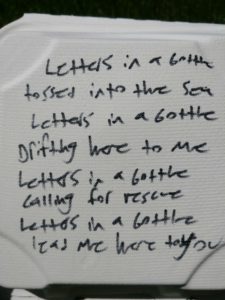
While I ate, I found myself running lyrics through my mind. Having no paper on me, I opted to write the words on top of the cardboard lunchbox with a sharpie.
Letters in a bottle
Tossed into the sea
Letters in a bottle
Drifting here to me
Letters in a bottle
Calling for rescue
Letters in a bottle
Lead me here to you
I took a photo, then threw the lunchbox out. On the way back, I made a voice note, recording a basic melody for the chorus. Within the next few days, I made my way to the music rooms, and worked out the melody on the piano.
When I first started writing Letters, I was planning on it being a love song. Inspired again by Irish music, specifically a song called The Voyage, I wanted to write about a man in a boat, searching for his lost love.
As it developed, though, the initial idea didn’t sit right with me. Something told me that this song was going to be different, and writing a run-of-the-mill love song wasn’t going to cut it. Like a caterpillar turning to a butterfly, it metamorphosed into a beautiful blossom of lyric and melody.
As is common, the original chorus had to experience revisions before I accepted it as a full-fledged song. Now, it goes like this:
Letters in a bottle
Tossed into the sea
Letters in a bottle
Drifting up to me
Upon the careworn parchment
A map I hope is true
For this letter in a bottle
Should lead me straight to you
Unlike To Write Love, there isn’t an explicit message all the way through. Unlike Everett McGill, there’s significant meaning assigned to every single verse and chorus. The Letter in the Bottle that is tossed into the sea is a cry for help – an understanding that you cannot do it on your own. Those who pick it up are those who love you. Those who will listen and follow your cry – your letter – to find where you stand.
Here, the pleasure of creation and the contemplation of philosophy joined in union to design a meaning that I think is deeper than the other two songs.
As I played for my friends, this song quickly became a favorite. One friend in particular would always ask for it when we met up in the music rooms. She told me she didn’t want to be a bother by asking for it, but I would always shake it off. It’s a song that, among friends, I was ready and willing to share. The outside world, on the other hand, was a different story.
I refused to record any full versions of the song, only playing it live, because I wasn’t ready for it to be open to the general public. There was something special about this song, something that I wanted to hold on to. Finally, though, I realized I couldn’t keep it any longer.
Letters in a Bottle will not only be featured on the EP I’m hoping to release within the next year, but will be the title track. I don’t speak in hyperbole when I say writing this song has changed my life, and I’m hoping that it will change the lives of those who hear it.
That was a lot of words – let me review.
To Write Love taught me the importance of words, and that I cannot lie when writing music.
Everett McGill taught me that, when writing music, you can have fun. There’s no requirement for deep, serious meaning in every song. It’s like a smile in the middle of a tough time – a breath of a fresh air after being stuck in a stuffy attic.
Letters in a Bottle taught be to be open to change. The idea you had at the start doesn’t need to stay the same throughout the entire project. After all, the caterpillar becomes a butterfly.
When writing, meaning can be explicit, implicit, or non-existent. But that doesn’t mean other meanings won’t be attached to it. Art, especially music, connects with people in a way that’s different from anything else, because in it, you can say how you feel, without ever saying anything at all.
As an artist, understand that the meaning you include in a work may not be the meaning that people associate with it later. More specifically as a Christian, you should be open to letting God change whatever meaning you originally intended.
So, be open to changes in meaning. And whatever you do, write well.